Impact of Spectral Aerosol Radiative Forcing at the Izaña Observatory during the August 2023 Extreme Wildfires
Principal Investigator: Rosa García Cabrera
Institution name: TRAGSATEC-AEMET
Scientific objective
Extreme wildfires represent a highly variable source of atmospheric aerosols with potentially strong impacts on surface solar radiation. In August 2023, an exceptional wildfire on Tenerife (Canary Islands, Spain) reached the neighbourhoods of the Izaña Observatory (IZO, 2400 m a.s.l.). This near-source configuration enabled a rare observational characterisation of the spectral radiative effects of biomass-burning aerosols (Figure). During the most intense phases of the event (17–18 August), aerosol optical depth (AOD) at 500 nm reached extreme values of 3.63 and 2.25, respectively, with Ångström Exponent (AE) above, indicating a strong dominance of fine-mode smoke particles. Spectral measurements of global-horizontal, direct-normal and diffuse-horizontal solar irradiance (300–1100 nm) show a pronounced attenuation of direct and global irradiances, particularly in the visible range, together with a strong enhancement of diffuse radiation. Relative to clean-sky conditions, daily global irradiance decreased by 21–27 %, while direct-normal irradiance was reduced by 72–99 % (Figure 2).
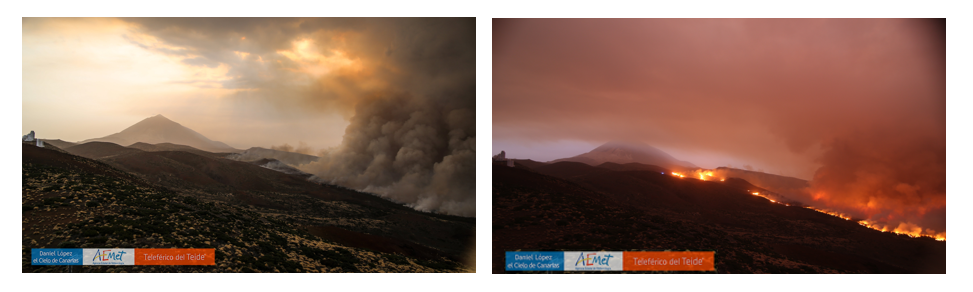
Figure 1.- Images of Teide National Park captured on 17 and 18 August 2023 from Izaña Observatory (Teide Cloud Laboratory Project, project from Izaña Observatory by Daniel López).
Spectral aerosol radiative forcing and radiative forcing efficiency at the surface were quantified using radiative transfer simulations under pristine atmospheric conditions as a reference. The integrated spectral radiative forcing (300-1100 nm) for global irradiance reached -395 and -299 W m−2 on 17 and 18 August, respectively, indicating strong surface cooling dominated by scattering processes. Maximum forcing and efficiency occurred in the visible spectral range, consistent with the optical properties of freshly emitted smoke aerosols. At the same time, increases in the amount of present particles, equivalent black carbon (eBC) and greenhouse gases (CO2, CH4 and CO) confirm the direct influence of the wildfire plume on atmospheric composition at IZO. These observations provide one of the few detailed spectral assessments of surface radiative forcing by extreme biomass-burning aerosols at a high-altitude site and highlight the need to accurately represent fine-mode smoke aerosols in radiative transfer and climate models.
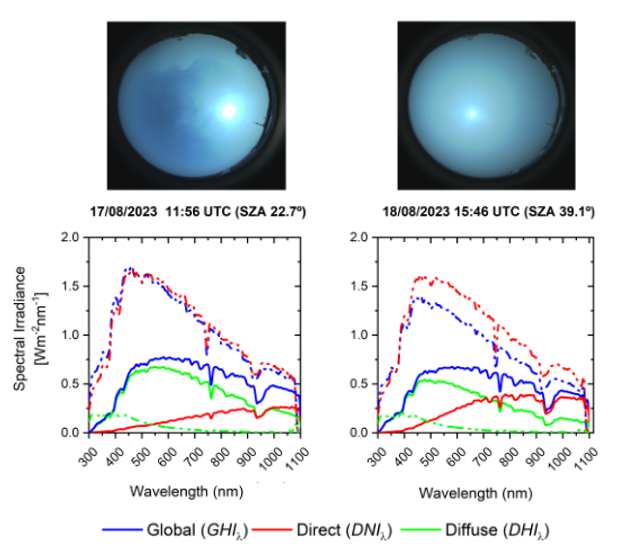
Figure 2.- Spectral irradiance (W m−2nm−1) obtained from EKO RSB measurements at IZO on 17 and 18 August 2023 at 11:56 UTC (SZA = 22.7◦) and 15:46 UTC (SZA = 39.1◦), respectively. The blue, red, and green lines represent global (GHIλ) direct-normal (DNIλ), and diffuse (DHIλ) irradiance components, respectively. The sky-camera images show the corresponding sky conditions at each time.
Publications
- García, R. D., Barreto, Á., Cachorro, V. E., González-Sicilia, P., León-Luis, S., Alvárez-Hernández, A., Bustos, J. J., Ramos, R., Almansa, F., Álvarez-Losada, Ó., González, Y., Rivas, P. P., and Torres, C. J.: Impact of Spectral Aerosol Radiative Forcing at the Izaña Observatory during the August 2023 Extreme Wildfires, EGUsphere [preprint], https://doi.org/10.5194/egusphere-2026-306, 2026.